French at Swillington
'You live a new life for every language you speak. If youonly speak one language, you only live once.'
Czech Proverb
Across the BLP, schools electing to teach French follow thecurriculum written by leaders and specialists across the trust. Staff atSwillington hope that children become enthused language learners by the timethey leave us at the end of Year 6, understanding that a little language can goa long way. We want pupils to appreciate the range of doors that learning alanguage can open, to understand that letter-sound correspondences vary betweenlanguages and to realise that speaking another language is not merely learningand swapping a huge list of words. We hope that children begin to seeconnections between English and other languages.
Learning a language, even just a few words, helps us toappreciate the cultures of others. In lessons, children have opportunities topresent and perform. These are all skills that will benefit language learninglater in life, even if children don't study French at secondary school.
At Swillington Primary school, children in Key Stage Twolearn French. Each class has a dedicated hour slot per week. Children areencouraged to practise informally between lessons, and revision resources suchas ‘Duolingo’ are put onto class dojofor children to use, should they wish.
Our planning in French works on a ‘pass-to-progress model’.Year groups follow the plan for French prescribed by the BLP curriculum at therate that is suitable for them, only moving on when they have mastered thecontent in that unit. Across the scheme of work, there are proportionateopportunities to read, write, speak and listen for each objective.
We devote as much time revisiting and revising previouslylearnt content as teaching new content. Our teaching involves using phonicstrategies to ensure children pronounce words accurately and beautifully.Children have opportunities to practise the spelling and writing of key phrasesas well as discussion. Often, we will introduce phrases with their literaltranslations (Did you know that the French say ‘I have ten years’ instead of ‘Iam ten years old’?) so that children can understand how the language isconstructed, which will help them manipulate and construct new sentences.
Please find our long-term plan for French below. Note thatit will develop over time to include more units as children become morefamiliar with the language.
Click here to see our French long-term plan.
Assessment in French most regularly takes place whenrevisiting content at distance. This happens each lesson. At the end of a unitchildren recap their learning for that block of learning and sit a minisummative assessment to inform future reteaching. Language learnt in one unitdirectly feeds into subsequent learning.
How to Help at Home
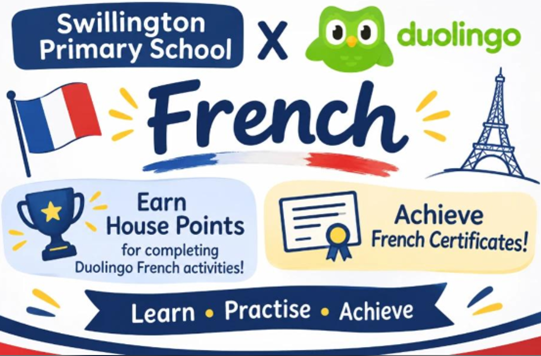
Make a Duolingo account and have the chance to win Housepoints and Certificates from Miss Garside!
Link: www.duolingo.com/classroom/kpukzq
Classroom code: kpukzq
Helpful Documents
